ORIGINAL SCIENCE

Cannistraci–Hebb
Training

Intelligence learns to build its own structure. Connectivity shapes how information flows. CHT uses local network topology to guide connection regrowth as the network evolves during sparse training.

From connection strength
to connection structure.

Weights describe connection strength; topology describes which units are connected. CHT explores how these connections can be organized through a sparse training process that continually updates network structure.

Read the NeurIPS 2025 paper
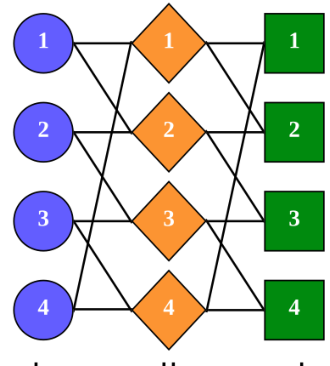
Cannistraci–Hebb TrainingNeurIPS 2025 · FIG. 1
CHTsI      II      IIISparse initialization
01

Sparse initialization

Begin with a sparse connectivity structure.

A guided reading of the original research figure · View source
See structure evolve.

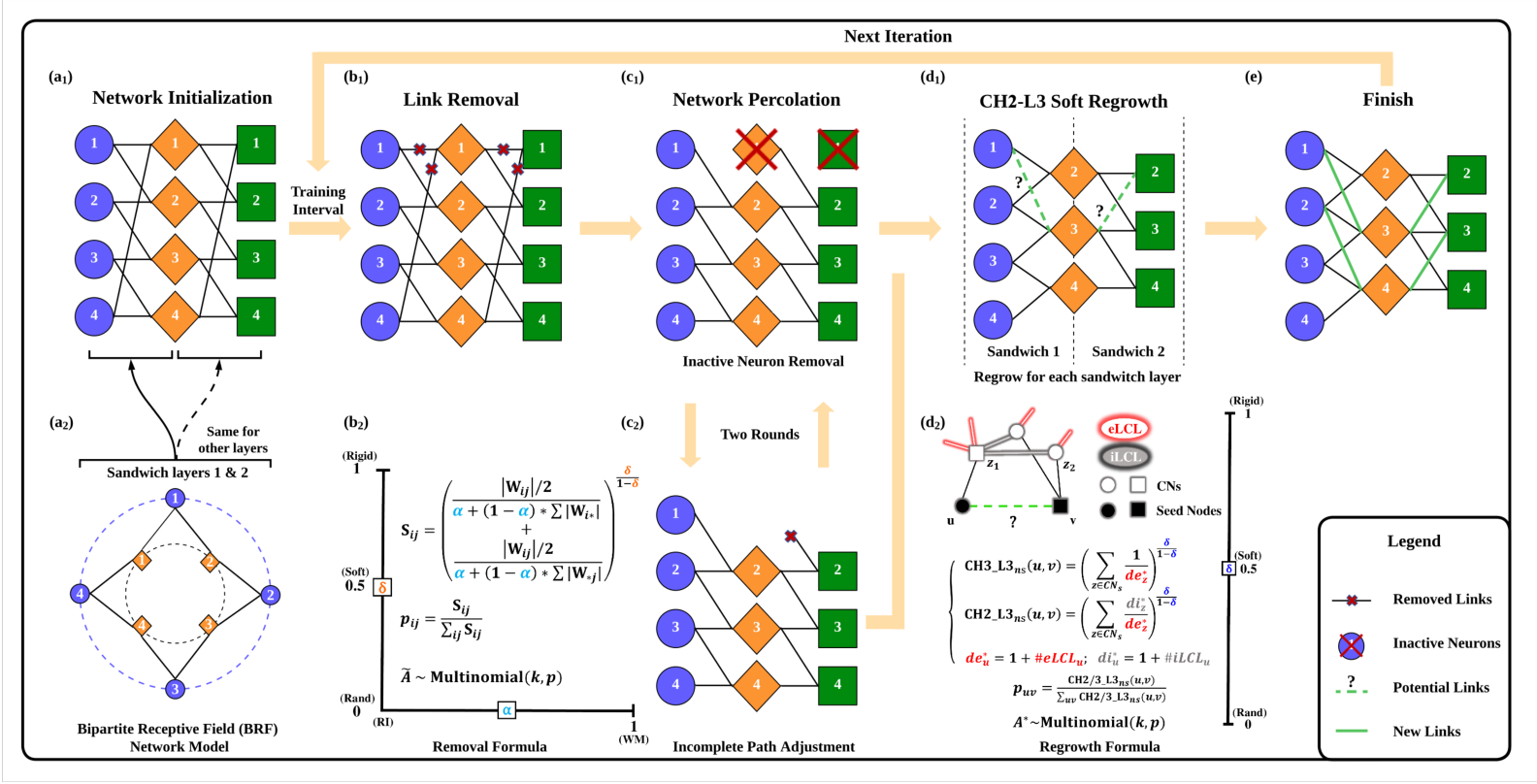
CHTs process: sparse initialization, connection removal, network percolation and topology-guided regrowth

NeurIPS 2025 · Zhang et al. · Figure 1: the CHTs training process. Click to enlarge. Source

01Sparse initialization
02Connection removal
03Network percolation
04Topology-guided regrowth
05Resume training

One original paradigm.
Multiple paths to efficient AI.

  • Dynamic sparse learningUpdate connections during training and study how sparse structure adapts to a task.
  • Semi-structured trainingLearn connectivity under constraints such as N:M patterns supported by hardware.
  • Spiking neural networksExplore the interaction between connectivity and event-driven computation.

From scientific foundations
to an expanding research frontier.

A collection of core CHT papers, public preprints, foundational studies and related sparse-learning research, checked against public sources. Publication status is stated for each entry.

Core CHT research

2026NeurIPS 2026 · accepted

SCHTs: A Semi-Structured Dynamic Sparse Training Framework for Hardware-Efficient Deep Learning

Combines dynamic sparse learning with N:M constraints to connect model training with hardware design.

Read paper
2026NeurIPS 2026 · accepted

Cannistraci-Hebb Channel-wise Dynamic Sparse Training of Convolutional Neural Networks with Contextual Modulation

Extends CHT to convolutional networks through channel-wise topology and contextual modulation.

Read paper
2026ICLR 2026

Cannistraci-Hebb Training on Ultra-Sparse Spiking Neural Networks

Brings topology-guided dynamic sparse training to spiking neural networks.

Read paper
2026ICLR 2026

Alignment-Enhanced Integration of Connectivity and Spectral Sparsity in Dynamic Sparse Training of LLM

Studies alignment between connectivity and spectral sparsity for parameter-efficient language-model training.

Read paper
2026CPAL 2026 · PMLR 328

Cannistraci-Hebb Training with N:M Semi-Structured Sparsity for Pre-Training and Re-Training

Introduces CHTs24 and a dynamic sparse retraining pipeline for hardware-compatible patterns.

Read paper
2025NeurIPS 2025

Brain network science modelling of sparse neural networks enables Transformers and LLMs to perform as fully connected

Introduces the CHTs soft rule for topology exploration and connectivity updates in Transformers and language models.

Read paper
2024ICLR 2024

Epitopological learning and Cannistraci-Hebb network shape intelligence brain-inspired theory for ultra-sparse advantage in deep learning

Establishes ESML and the CHT framework for learning with ultra-sparse connectivity.

Read paper

CHT preprints and research reports

2026Preprint · v1

Towards NVIDIA 1:4 Semi-Structured 75% Sparsity via Cannistraci–Hebb N:M Dynamic Sparse-to-Sparse Training

Explores N:M sparse-to-sparse training at higher sparsity with optimizer co-design.

Read paper
2026Preprint · v3

Constructing Brain-Inspired Sparse Topologies for Energy-Efficient ANN-to-SNN Conversion via Cannistraci-Hebb Training

Studies how topologies learned through sparse training transfer into ANN-to-SNN conversion.

Read paper
2025Preprint · v1

Cannistraci-Hebb Training of Convolutional Neural Networks

Explores CHT under convolutional weight sharing and receptive-field constraints; listed as an early research report.

Read paper

Foundations and network science

2025NeurIPS 2025

Adaptive Cannistraci-Hebb Network Automata Modelling of Complex Networks for Path-based Link Prediction

Extends local-topology link-prediction rules that underpin structural learning.

Read paper
2018Scientific Reports

Modelling Self-Organization in Complex Networks Via a Brain-Inspired Network Automata Theory Improves Link Reliability in Protein Interactomes

Studies local-topology-driven link growth and network self-organization.

Read paper
2017Applied Network Science

Can local-community-paradigm and epitopological learning enhance our understanding of how local brain connectivity is able to process, learn and memorize chronic pain?

Investigates epitopological learning through the rewiring of brain networks.

Read paper
2015New Journal of Physics

Common neighbours and the local-community-paradigm for topological link prediction in bipartite networks

Extends the local-community paradigm to topological link prediction in bipartite networks.

Read paper
2013Scientific Reports

From link-prediction in brain connectomes and protein interactomes to the local-community-paradigm in complex networks

Studies how local connectivity organization informs link prediction in complex networks.

Read paper

Complementary sparse-learning research

2026Preprint · v2

A Dendritic-Inspired Network Science Generative Model for Topological Initialization of Connectivity in Sparse Artificial Neural Networks

A complementary study of topology initialization for sparse learning, distinct from CHT itself.

Read paper
2025ICML 2025 · PMLR 267

Sparse Spectral Training and Inference on Euclidean and Hyperbolic Neural Networks

Explores parameter-efficient training through spectral representations, complementary to connectivity sparsity.

Read paper
2025ICML 2025 · PMLR 267

Pivoting Factorization: A Compact Meta Low-Rank Representation of Sparsity for Efficient Inference in Large Language Models

Studies compact model representations for inference; its results are distinct from CHT performance.

Read paper

Verified November 15, 2026 against public primary sources. Updated as the research evolves.